Sub-Zero Freezer Repair
Frost Building Up Inside a Sub-Zero Freezer: Seal, Heater or Sensor
Four things put a sheet of frost on the back wall of a Sub-Zero freezer, and only one is expensive. Sub-Zero Repair Woodinville, (425) 321-3414.
Set down by
Dean Halvorsen
Bench sealed systems and airflow · Years at it 19
EPA 608 certified
Frost inside a Sub-Zero freezer is not a cosmetic problem, and it is not something the cabinet does because it is old. Every built-in freezer of this type runs an automatic defrost cycle specifically so that ice never accumulates on the evaporator. When you can see a sheet of it — on the rear panel, around the drawer runners, along the top of the compartment — the cycle is either not running or it is losing a race against moisture getting in.
Separating those two answers is most of the job. One of them ends at a gasket; the other does not. And they are easy enough to tell apart, provided you know what you are looking at.
What the defrost cycle is actually doing
The evaporator is the coil that gets cold. Air is blown across it, chilled, and circulated through the compartment. Everything that passes over that coil carries some moisture, and that moisture condenses and freezes onto the fins. Left alone, the coil would ice solid within weeks.
So on a schedule — typically counted in compressor run hours rather than clock hours — the system stops cooling and energises a heater bonded to the evaporator. The ice melts, runs down into a drain trough, out through a drain line, and evaporates in a pan near the compressor. Then cooling resumes. Done properly, you never see any of it happen.
Three components have to work for that to complete: the defrost heater, the termination thermostat or sensor that decides when the coil is clear, and the control that starts the cycle. If any one of them fails, ice starts accumulating and never leaves.
Frost on the coil versus frost on the contents
Where the ice is tells you a great deal, and this is the single most useful observation you can make before calling anyone.
Ice behind the rear panel, on the coil itself. Symptoms: the freezer is warming, the fan sounds loud or is scraping, and airflow from the vents is weak or absent. This is a defrost circuit failure. The coil has iced over, the fan is hitting the ice, and cold air is no longer reaching the compartment.
Ice on the drawer front, the gasket, the runners or the packaging. Symptoms: temperature is roughly correct, but there is white fur on the surfaces near the opening. This is warm, humid room air getting past a seal. It is a door or gasket problem, and it is cheap.
Ice in the bottom of the compartment as a solid slab. This is usually a blocked defrost drain. The cycle is running and melting the ice as designed, but the meltwater cannot get out, so it refreezes on the compartment floor instead. Common on units that have had an ice maker leak upstream.
Ice everywhere at once normally means the door has been left ajar, or a drawer has been over-packed and is not sealing shut. Woodinville kitchens with integrated columns are particularly prone to this, because a panel-ready door that is not closing flush does not look wrong from across the room.
What to check before booking a visit
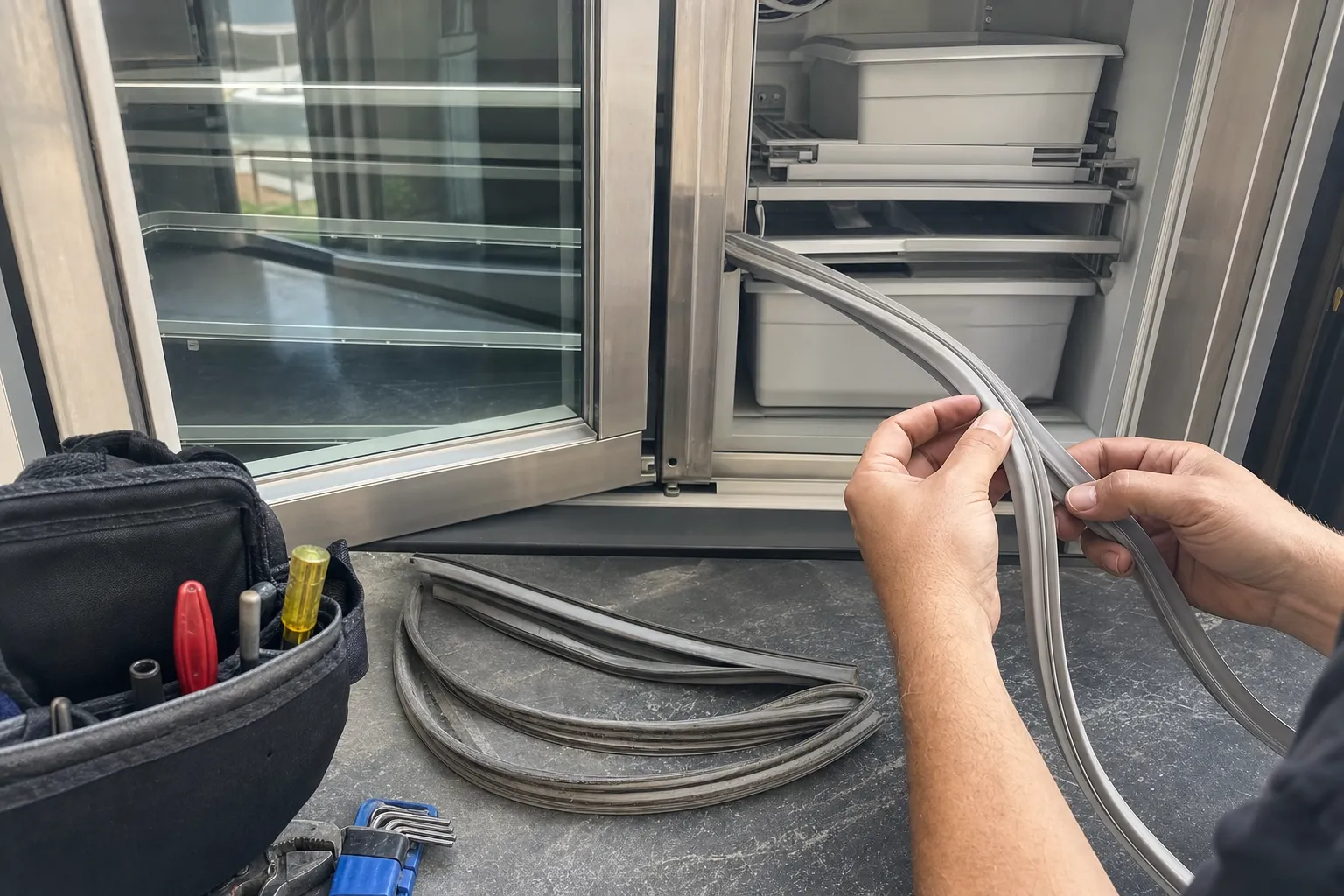
Shut the drawer or the door on a sheet of paper, then pull the paper back out. Where it comes away freely, the seal has no grip on it. Repeat that around the entire perimeter and the gap will show itself. A gasket that has taken a set, or has a torn corner, can be replaced without touching the refrigeration system at all.
Then look at the gasket itself in good light. Splits, flattened sections and hardened rubber are all visible once you know to look. On integrated units, check the door is actually closing flush against the cabinet — hinges that have dropped over the years will hold a heavy panel a few millimetres proud, which is enough.
Finally, note whether the freezer is holding temperature. A freezer that is frosting but still sitting at 0°F is a moisture problem. A freezer that is frosting and has crept up to 10°F or 15°F has an airflow problem behind the panel, and that is the defrost circuit.
When it is worth calling someone out
If the ice is behind the rear panel, call. Getting to the evaporator means removing the panel and usually the fan assembly, testing the heater for continuity, checking the termination thermostat and confirming the control is actually initiating the cycle. That is a methodical job with the cabinet open, and it is not something to work through by substitution — replacing parts one at a time until the ice stops is an expensive way to find an inexpensive sensor.
Call promptly, too. A freezer running with an iced evaporator is a compressor working continuously against a load it can never satisfy. The longer that goes on, the more likely a cheap defrost repair turns into an expensive one.
If the ice is at the opening and the temperature is fine, you have time. Order the gasket, or have it done on the next visit for something else. That fault wastes energy and produces frost, but it is not doing the machine any structural harm while you wait. Both kinds of repair, and the bands they are priced from, are laid out on the cost page.
Common follow-ups
- Is some frost in a Sub-Zero freezer normal?
- A light dusting on packaging is normal, especially in a drawer that gets opened often. A solid sheet on the rear panel, or ice that returns within days of being chipped off, is not — that is a defrost or moisture-ingress fault and it will keep getting worse.
- Will defrosting the unit manually fix it?
- It clears the symptom for a while. If the underlying cause is a failed heater, a stuck thermostat or a bad gasket, the ice comes back on the same schedule it did before. Manual defrosting is a way to buy time, not a repair.
- Why does frost make the freezer warmer rather than colder?
- Ice on the evaporator insulates it from the air it is supposed to be chilling, and eventually blocks the airflow through the coil entirely. The compressor keeps running, the cabinet keeps warming, and the unit works harder while performing worse.