Sub-Zero Wine Cooler Repair
Sub-Zero Wine Cooler Holding the Wrong Temperature in One Zone
One zone drifting while the other holds is almost never the compressor. What the gap points at. Sub-Zero Repair Woodinville, (425) 321-3414.
Set down by
Dean Halvorsen
Bench sealed systems and airflow · Years at it 19
EPA 608 certified
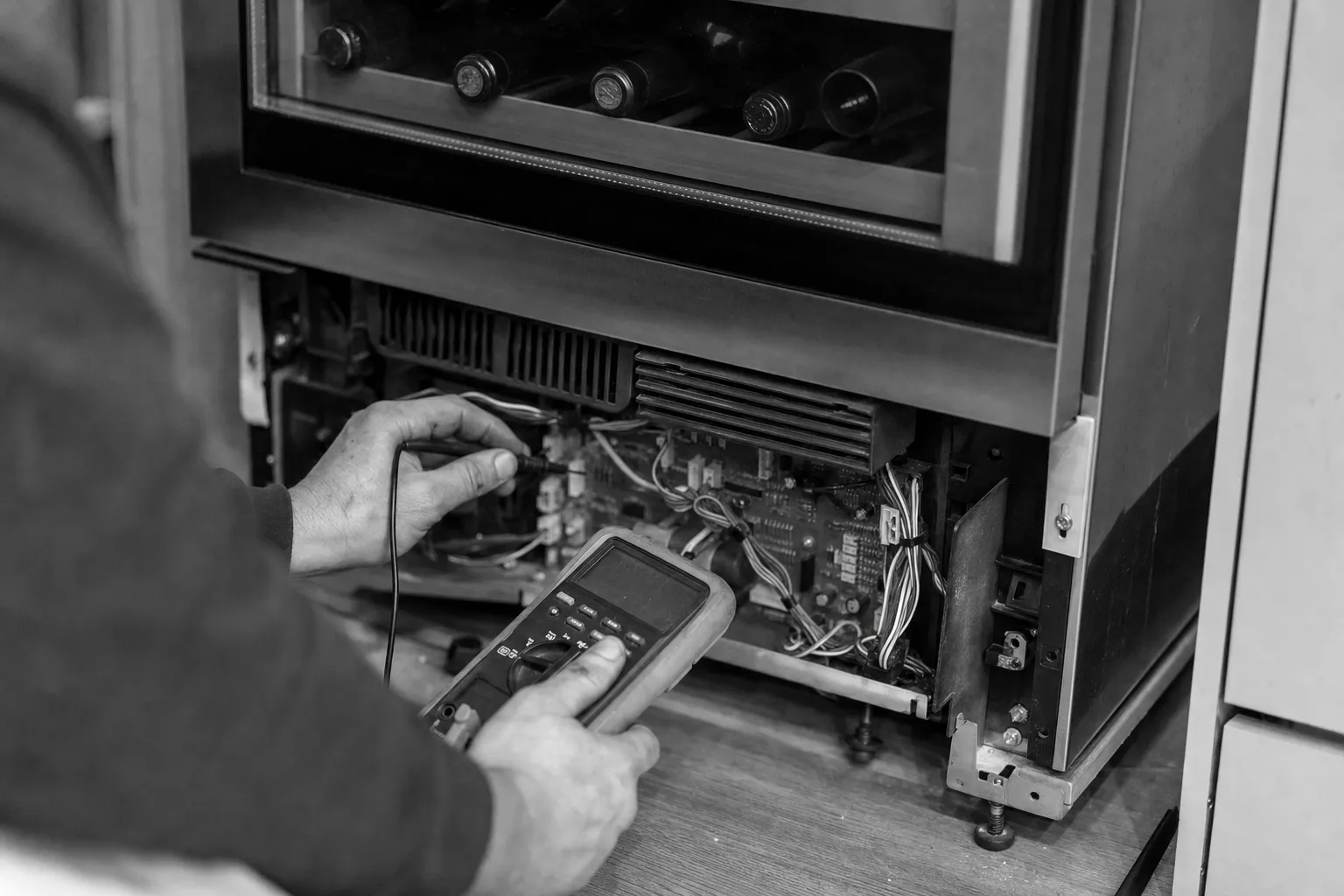
A dual-zone Sub-Zero wine cabinet that has gone four degrees warm in the upper zone while the lower zone sits exactly where it should is one of the most misdiagnosed faults we see in Woodinville. It gets quoted as a compressor failure, and on the strength of that quote people replace cabinets that had nothing structurally wrong with them.
The reasoning behind the wrong answer is understandable. A zone is warm, refrigeration is not happening, therefore the thing that makes cold has failed. But many two-zone cabinets make all their cold in one refrigeration system and divide it between the compartments — and when the division stops working, exactly one zone goes wrong while the other looks perfect. On a single-system cabinet a failed compressor cannot do that; it would take both zones with it. The older 400 series is the exception worth knowing: Sub-Zero built the 424, 427 and 430 with a separate refrigeration system for each zone, so on those a lone warm zone can be that zone’s own sealed system.
Why one zone can drift and the other cannot
On a single-system dual-zone unit, the cold air produced by one evaporator is apportioned between the two compartments. Depending on the model family that is done with a damper, a second evaporator fan, or a divider with its own airflow path. Each zone has its own thermistor reporting back to the control board, and the board opens, closes or runs whichever component regulates the split.
That gives you a short list of things that can go wrong in one zone alone:
- the damper or divider for the warm zone stalls part-open or part-closed
- the zone fan for that compartment seizes or slows
- the thermistor in that zone reports a temperature the compartment is not actually at, so the board never calls for more cooling
- the airflow path is blocked — usually by bottles pushed hard against the rear wall, which is far more common than anyone expects
Every one of those is a small, priced-in-advance part. None of them is a sealed system repair. If a technician arrives, does not open the cabinet, and quotes a compressor from the symptom description alone, you have learned something useful about that technician.
What the numbers are worth reading
Before you call anyone, spend ten minutes gathering readings, because they narrow the fault more than any description can. If you are not sure which unit you have, the models page shows where Sub-Zero puts the tag on each family.
Put an independent thermometer in each zone, near the middle, away from the rear wall. Leave the door shut for two hours. Then compare all four numbers: setpoint and actual, for both zones.
- Both zones warm by a similar amount — that is a whole-system problem: airflow at the condenser, a refrigerant issue, or a condenser fan. Not a zone fault at all.
- One zone warm, one exact — a division fault, as above.
- One zone warm and the display insists it is fine — the thermistor in that zone is the first suspect. The board is not failing to cool; it does not believe cooling is required.
- Warm zone slowly getting worse over weeks — think airflow restriction or a fan winding down, rather than a component that has simply failed outright.
Write the numbers down with the date. A cabinet that has drifted two degrees in a month behaves differently from one that went wrong overnight, and that history changes what gets checked first.
The two things worth doing yourself
Pull the bottles away from the rear wall. In a full cabinet — and in Woodinville, cabinets are full — the back row often ends up pressed against the air outlets. A blocked return path will warm one zone by several degrees and it costs nothing to rule out. Leave a finger’s width behind the last row and give it a day.
Clean the condenser. Behind the lower grille there is a coil, and in a house with dogs, a fireplace or a gravel drive it will be matted. A blanketed condenser cannot reject heat, and the zone furthest from the evaporator is the one that suffers first. A vacuum, a soft brush and fifteen minutes is the whole job. This alone resolves a meaningful share of the calls we take in the summer months, when ambient temperatures in the room are already working against the cabinet.
If both of those are clean and the gap is still there after twenty-four hours, the fault is inside the airflow control and it is a service visit.
When it genuinely is the sealed system
There are symptoms that do point at refrigeration itself, and they look nothing like a single warm zone. Both zones climbing together. A compressor that runs continuously and never satisfies. A condenser that is stone cold when the compressor is running, or frost forming on the suction line where it enters the cabinet. Those are gauge-and-diagnose situations, and on a wine cabinet the charge is small enough that they need doing properly rather than topped up on a guess.
The distinction matters because of what it costs. A damper motor and an afternoon is one kind of bill. A sealed system repair on a wine cabinet is another kind entirely, and it is worth being certain which one you are actually buying before anyone opens the refrigeration circuit. Both lines, with their ranges, are on the cost page.
Common follow-ups
- How much drift is actually a problem in a wine cabinet?
- A degree or two of swing across a cycle is normal and harmless. A zone that has settled three or more degrees off its setpoint and stays there is a fault, and it will age the bottles in that zone faster than the ones below it.
- Does a wine unit need a different refrigerant charge than a refrigerator?
- The system is smaller and the target temperatures are much higher, so it runs a lighter charge and is far more sensitive to being over or undercharged. That is exactly why guessing at a top-up instead of gauging the system tends to make a drifting cabinet worse.
- Can I keep using the cabinet while I wait for a repair?
- Usually yes. If one zone is warm, move anything you care about into the zone that is still holding and leave the door shut. A wine unit that is four degrees warm is a slow problem, not an emergency, provided it is not climbing further.